
“My main goal at all times is to make my product as cost-effective as possible for my clientele.
The M&T system is truly the answer; you save on all levels when it comes to materials,
labour and maintenance.”
Pieter Theron (Co-designer M&T Systems)

Who is M&T Plastiek?
Today, M&T is still a family business. Pieter Theron, and his daughter Marisa van Zyl are at the helm of the industry, and their first consideration is always to make the product as cost-effective as possible for their customers.
How do I know which M&T system is suitable for my needs?
The M&T equipment is mainly designed for livestock watering purposes. It is important to determine which M&T system will best serve a given borehole. The M&T 45-meter system is sufficient for any water level shallower than 45 meters. Once water levels go deeper than that, the M&T 60-meter system is the answer. However, make completely sure that this is indeed the case. It is our experience that most boreholes deliver water within 45 meters.
The M&T force head system is used to elevate water up to 10 m over 1km. See the patent below for further details.
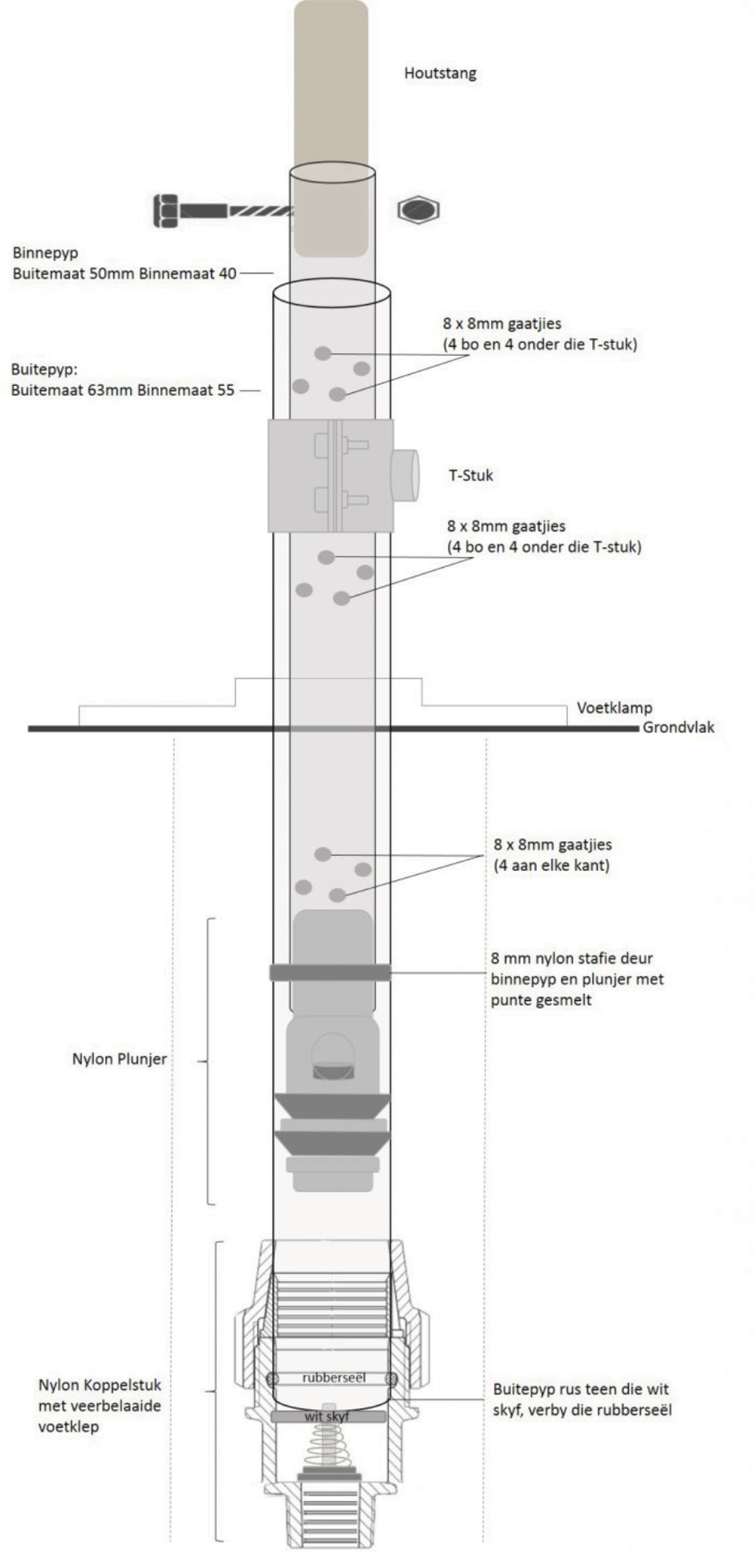
What do you need to set up the system?
Users of M&T systems have to purchase their own plastic pipes, which are readily available from farming cooperatives. Find a complete list of necessities below:
- The appropriate M&T system (For sale at BKB. Contact us if you do not have a BKB near you.)
- SABS pipes or SABS standard pipes (outer pipe with outer dimension 63mm, inner dimension 55mm; inner pipe with outer dimension 50mm, inner dimension 40mm) (For sale at BKB as well as other farming cooperatives and industrial suppliers.)
- A cordless drill, 8mm drill bit and 25mm wood drill bit
- 8mm bolt & nut to fit through the wooden rod
- Gas burner and piece of metal to melt & forge the tips of the nylon rod
- Hammer and water-pump pliers
- No. 13 Wrench, wrench and chain or pipe wrench
- Star screwdriver
- Hacksaw
- Measuring tape
- 32 mm coupling for the T-piece and 32 mm pipe to divert water to the dam
There is no cylinder; the system forms its own cylinder.